You run a full dishwasher cycle. You’re expecting that clean, soapy, lemony kitchen smell that makes you feel like a functioning adult. Instead, you open the door and get hit with something that smells like a crab pot left out in August. In Baltimore. On a hot day.
Sound familiar? Hi, I’m Bailey, and I’ve seen the inside of more dishwashers than I care to admit. Here’s the truth no appliance manual will tell you: your dishwasher is dirty, and it has been for a while. That’s not a judgment – that’s just biology and plumbing conspiring against you. The good news? You can fix it in about 20 minutes with supplies you already have under your sink, and I’m going to walk you through every single step.
Why Does My Dishwasher Smell Like a Retired Fishing Boat?
Here’s the misconception that gets almost everyone: because your dishwasher uses hot water and soap on a daily basis, it must be cleaning itself along the way. It is not. Not even a little bit.
What’s actually happening inside your dishwasher is less “sparkling appliance working hard” and more “warm, dark, damp enclosed space where food particles and grease go to slowly decompose.” Bacteria and mold absolutely love those conditions. They thrive in them. While your dishwasher is busy cleaning your plates, a very different kind of activity is happening in the corners, the seals, and the drain – and over time, all of that biological activity produces a smell that no amount of lemon-scented detergent pods can cover up.
The machine isn’t broken. It’s just neglected. And once you understand where the smell is actually coming from, fixing it becomes pretty straightforward.
Meet Your Dishwasher’s Most-Neglected Feature: The Filter
If you’ve never cleaned your dishwasher filter, I need you to take a deep breath before we continue.
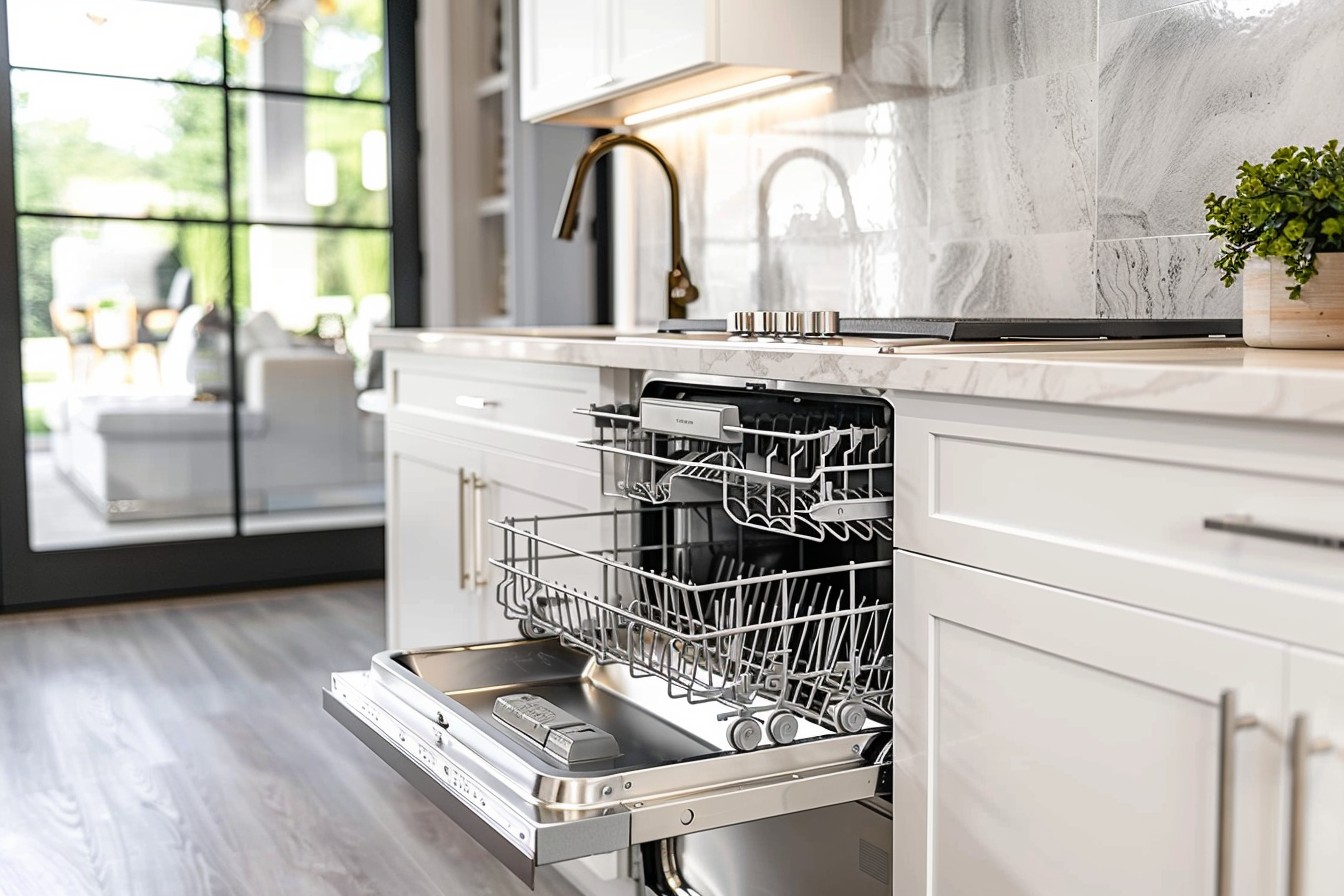
Most modern dishwashers have a cylindrical mesh filter sitting right at the bottom of the tub, usually underneath the lower spray arm. Its job is to catch food debris so it doesn’t recirculate onto your dishes during a cycle. Noble work. The problem is that every scrap of food it catches just… stays there. Wet. Warm. Sitting in standing water between cycles. Slowly becoming something you do not want to think about too hard.
I have lifted dishwasher filters that looked like crime scenes. Layers of compacted food particles, grease buildup, and a smell that would make a grown adult step back and reconsider their life choices. This is the single biggest source of dishwasher odor in most homes, and it’s also the most fixable.
If you’re not sure where your filter is, check your manual or just Google your dishwasher model – it takes about 30 seconds. Most twist out counterclockwise.
The Drain Hose – The Villain You Didn’t See Coming
While the filter is the most common culprit, the drain hose deserves a mention because it’s responsible for some of the worst cases I’ve encountered on the job.
The drain hose connects your dishwasher to either your garbage disposal or your sink drain. If it isn’t looped high enough under the counter before connecting – what plumbers call a “high loop” – dirty water from the sink or disposal can backflow directly into the dishwasher. Essentially, your machine fills up with grimy water between cycles without you ever knowing, and that water sits there and stinks.
This is a quick visual check: pull out the kickplate at the bottom of your dishwasher and look at how the drain hose is routed. If it sags straight from the dishwasher to the drain with no upward loop, that may be part of your problem. Fixing the loop itself is usually a DIY job with a zip tie and a cabinet screw. If the hose looks cracked, kinked, or genuinely gross inside, that’s a call for a plumber.
The Supporting Cast of Smell (AKA Other Sneaky Culprits)
The filter and the drain hose are the headliners, but they’ve got backup. A few other spots in your dishwasher quietly collect grime and contribute to the overall atmosphere – and they’re easy to miss precisely because they don’t look obviously dirty until you get up close.
The Door Seal – Where Mold Goes to Retire
Run your finger along the rubber gasket that lines the inside edge of your dishwasher door. Go ahead, I’ll wait.
If you pulled back a finger covered in black or dark grey gunk, congratulations – you’ve just met your door seal mold situation. The folds and ridges of that rubber gasket are a perfect trap for moisture and food splatter, and because the door seal isn’t inside the tub during a wash cycle, it never gets rinsed. It just sits there, damp, collecting debris, growing mold at its own quiet pace.
A healthy seal should be pliable, uniformly colored, and free of visible buildup. If yours looks dark and grimy in the folds, it’s contributing to your smell problem – and it takes about two minutes to address.
Detergent Buildup and Hard Water Deposits
This one tends to surprise people because it feels counterintuitive. More soap means cleaner, right? Not exactly.
Using too much detergent, or using a detergent that doesn’t fully dissolve, leaves a residue on the interior walls and spray arms of your dishwasher over time. That residue traps odors and creates a film that’s harder to rinse away with each subsequent cycle. Add hard water into the mix – and if you’re in Baltimore, you know our water is on the harder side – and you get mineral deposits layering on top of that residue, coating the interior in a dull, odor-holding film.
This is exactly why white vinegar is such an effective dishwasher treatment. The acidity cuts through both grease residue and mineral buildup in a way that regular dish detergent simply doesn’t.
The 20-Minute Fix That Actually Works
Alright, gloves on. Here’s the routine I use when I’m called in to deal with a dishwasher that’s making people wince. It costs almost nothing, uses supplies you already have, and it genuinely works.
Step 1 – Pull Out and Clean the Filter (5 Minutes)
Twist out your filter (counterclockwise for most models) and take it to the sink. Rinse it under warm running water to knock off the loose debris, then use a soft-bristle brush – an old toothbrush is perfect – and a drop of dish soap to scrub the mesh gently. Get into the pleats where gunk likes to hide.
One important note: do not use anything abrasive on the mesh. Steel wool or harsh scrubbers can damage the fine filter material and create gaps that let debris bypass the filter entirely. Soft brush, warm water, dish soap. That’s it.
Going forward, aim to clean your filter once a month. If you cook a lot or run the dishwasher daily, every two to three weeks is even better. Yes, really. It takes four minutes and the difference is dramatic.
Step 2 – Wipe Down the Seals, Spray Arms, and Interior Walls (7 Minutes)
Dip a cloth or sponge in a mixture of warm water and white vinegar – roughly equal parts – and work your way around the door gasket, pressing into the folds to pull out any mold or debris. For stubborn black spots, a little baking soda paste (baking soda mixed with just enough water to form a thick paste) applied with an old toothbrush works really well.
Next, check the spray arm holes – those small jets on the rotating arms at the bottom and top of the tub. They clog with mineral deposits and food particles more often than you’d think. A toothpick is perfect for clearing them out, and I will not pretend that this step isn’t oddly satisfying. It absolutely is.
Finally, give the interior walls a quick wipe-down with your vinegar cloth, paying extra attention to the corners and the area around the drain.
Step 3 – The Vinegar and Baking Soda Treatment (8 Minutes, Mostly Hands-Off)
This is the easy part. Place a dishwasher-safe cup or bowl filled with one cup of plain white vinegar on the top rack of your otherwise empty dishwasher. Run a hot water cycle. The vinegar will disperse during the cycle, cutting through grease residue, mineral deposits, and lingering bacteria throughout the interior.
Once that cycle finishes, sprinkle about a cup of baking soda across the floor of the dishwasher tub and run a short hot cycle. Baking soda is a natural deodorizer – it neutralizes odor molecules rather than just masking them, which is why it actually works instead of just temporarily covering up the problem.
Open the door after those two cycles and take a sniff. That is what your dishwasher is supposed to smell like – clean, neutral, nothing offensive. You’re welcome.
Keeping It That Way – Because You’re Not Doing This Again Next Week
The whole routine above becomes unnecessary if you build a few small habits into your regular kitchen rhythm.
Give plates a quick rinse before loading to reduce the food volume your filter has to handle. Run a hot cycle at least a few times a week rather than letting the machine sit damp and idle for days. Leave the dishwasher door cracked open after a cycle so moisture can escape instead of building up inside. And clean that filter monthly – put it in your phone calendar right now if you have to.
None of these steps take more than a minute on their own, but together they keep the bacteria and mold from ever getting a foothold. Your kitchen will smell better, your dishes will actually come out cleaner, and you’ll never have to do the full 20-minute rescue mission more than once or twice a year.
Small habits, big difference. That’s pretty much my whole philosophy in four words.